
The Rural Project
Improving Access to Diagnostic and Support Resources for Rural Populations Impacted by Multiple Sclerosis. A three-year project that began with MS in four states, designed to scale to other neurodegenerative diseases and a national footprint.
The four-state pilot region, anchored in Virginia and expanded with Bristol Myers Squibb Foundation funding.
Nearly $750,000
Adira's largest foundation grant to date, from Bristol Myers Squibb Foundation
Adira in Miniature
The Rural Project was Adira's model put into practice on a focused scale. The goal: improve access, delivery, and utilization of MS specialty care in rural areas of Maryland, North Carolina, Virginia, and West Virginia by bringing together an expanded coalition of community assets working toward shared goals.
The project launched in 2021 with funding from the Bristol Myers Squibb Foundation. Adira designed it to demonstrate the Adira approach in a contained setting and to secure co-financing to sustain and expand the effort nationally, eventually reaching neurodegenerative disease communities beyond MS. Read the assessment report here. Good news: We found a new home for this project with the Institute for Public Health Innovation.
5,000
estimated people living with multiple sclerosis served across the four target states
3 years
project duration
Why Rural Communities?
Rural communities face compounding barriers to neurodegenerative disease care that urban areas do not. Specialty providers are concentrated in cities. Telehealth helps but does not solve the gap. Patients in rural areas often go undiagnosed for longer, receive care from generalists less familiar with their specific conditions, and have fewer peer connections to others living with the same disease.
The current approach to rural ND care had three persistent problems:
Siloed programs leave out many people looking for help. A program built only for MS patients in suburban areas does not reach a person with MS living an hour from the nearest specialty clinic.
Finding, understanding, and using many siloed programs drains patients and caregivers of time, energy, and confidence.
Donors and providers utilize resources less effectively when they cannot easily reach the people who need them, struggling to grow and serve more people.
Adira's Fortified Approach
Adira applied four principles to the rural project, the same principles that anchored Adira's broader model:
Services expanded to serve common needs of five populations instead of one. Even though the project's funding focused on MS, the network map and infrastructure were built to scale to ALS, Alzheimer's and related dementias, Huntington's, and Parkinson's.
Existing health and health-adjacent networks were used to create more entry points to care. Parks systems, sports leagues, faith organizations. Not just medical providers.
Effective programs were scaled and replicated economically rather than built from scratch in each community.
People most impacted by MS were convened at the earliest stages of the project to provide insight and leadership to the intervention.
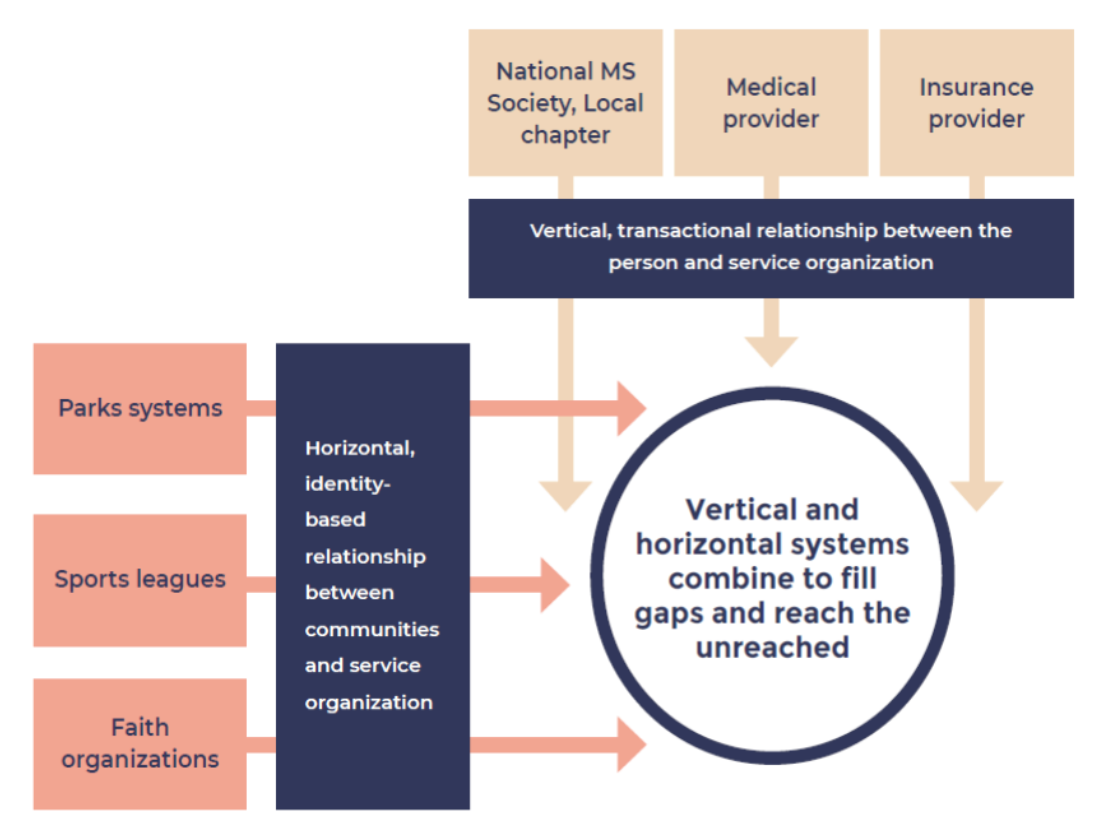
The result was a vertical and horizontal system that combined to fill gaps and reach the unreached. Traditional vertical relationships (between the patient and the MS Society chapter, the medical provider, or the insurance provider) continued to do their work. Adira added horizontal, identity-based relationships through community organizations the person already trusted.
Convenings
Bringing together people living with MS, caregivers, providers, community organizations, and partners in each of the four target states to set priorities and identify what was working and what was not.
Project Activities
The Rural Project worked across four interlocking activities, designed to reinforce one another.
Provider Training
Training rural providers on the risk factors, early symptoms, and treatment options for MS. The goal was to shorten the path to diagnosis and improve the quality of care from the first appointment forward.
Resource Identification and Network Map Expansion
Building on Adira's existing network mapping work with VirginiaNavigator. The Rural Project expanded the network map to include three new states (West Virginia, North Carolina, Maryland) and brought it to rural areas with a focused MS lens.
Public Health Education and Awareness
Public-facing education designed to help people in rural areas recognize MS symptoms earlier, find local providers and support resources, and connect with peers.
Partners
The Rural Project was a coalition effort. Adira worked alongside the funder and partner organizations to coordinate activities across the four states.
Bristol Myers Squibb Foundation — funder
VirginiaNavigator — network mapping infrastructure and rural expansion
National MS Society local chapters — coalition partners across the four states
Medical providers and insurance providers in each target region
Community organizations including parks systems, sports leagues, and faith-based groups
A Proof of Concept
The Rural Project was never just about MS in four states. It was Adira in miniature: a tightly defined project meant to demonstrate that the Adira model worked at scale, attract co-financing from other funders, and create a replicable approach.
The next phase, never realized before Adira sunset in late 2022, would have expanded the project to a national footprint and to neurodegenerative disease communities beyond MS. The infrastructure, the network map, the coalition relationships, and the lessons learned still exist as a foundation for any future effort.